
As of October 29, 2026.
On October 22, 2026, the British government asked its citizens to do something many families have never done: get their homes ready to manage on their own for three days if everyday services stop working.
It was not an alarm, and it was not a prediction of disaster. It was a calm, practical request. And because it comes from a major Western government, it is worth reading closely. The advice translates almost word for word to an American kitchen.
What the UK government actually said
The announcement came from the Cabinet Office and Security Minister Dan Jarvis, published on GOV.UK under the headline “Households encouraged to take small, simple steps to stay prepared in an emergency”.
According to that release:
- The advice is the first stage of a three-year campaign, called “Be Ready,” to help households across the UK prepare for events such as severe weather that can disrupt power, water, phones and the internet.
- The core idea is to be prepared for three days of disruption, the same standard used by France, Ireland and the Netherlands.
- The government points to storms last winter and wildfires this summer as examples of how severe weather can affect the services families rely on.
- More than five hundred organisations, from charities to businesses, have signed up to share the message.
- Several steps are free, such as signing up to the Priority Services Register, which helps gas, water and electricity companies identify customers who may need extra help in an emergency.
The release also notes that the UK has published household resilience advice since May 2024, and that much of it “has not changed.” The Be Ready campaign refreshes and expands that advice. It does not announce a new threat.
Mr. Jarvis put it this way: “Those who can follow this advice should follow this advice. By taking simple steps to be ready for everyday emergencies like severe storms, people can reduce pressure on emergency services, helping them prioritise people who need more support in an emergency.”
The wider context
The Guardian reported the same day that the campaign comes amid official concern about the climate, “technological dependency” and threats from hostile states. Defence Secretary Wes Streeting said Britain also needed to prepare for what he called “state-sponsored terrorism” aimed at everyday infrastructure, adding that households and businesses should ask themselves, “are they prepared? Are they ready?”
The Guardian also noted that ministers timed the launch ahead of the winter storm season, after a series of intense storms in recent years. Storm Goretti alone left tens of thousands of homes without power in January. The BBC covered the same three-day recommendation, quoting disaster-planning expert Professor Lucy Easthope, who said the goal is to make it easier for emergency services to cope in a national emergency.
So the UK message has two layers. The official advice is about everyday emergencies, such as storms and outages. Some ministers are also speaking openly about deliberate threats to infrastructure. Both point to the same household answer: a few days of supplies and a plan.
What the UK checklist recommends
The government’s Be Ready checklist is short and sensible. For three days, it recommends:
- Water: bottled water, 3 litres per person per day for drinking, with more needed for cooking and washing.
- Food: non-perishable food that doesn’t need refrigeration or cooking, such as tinned meat, fish or vegetables, dried fruit and nuts. The checklist adds that it’s best to buy food you’d usually eat.
- Hygiene: hand sanitiser, wet wipes and bathroom products.
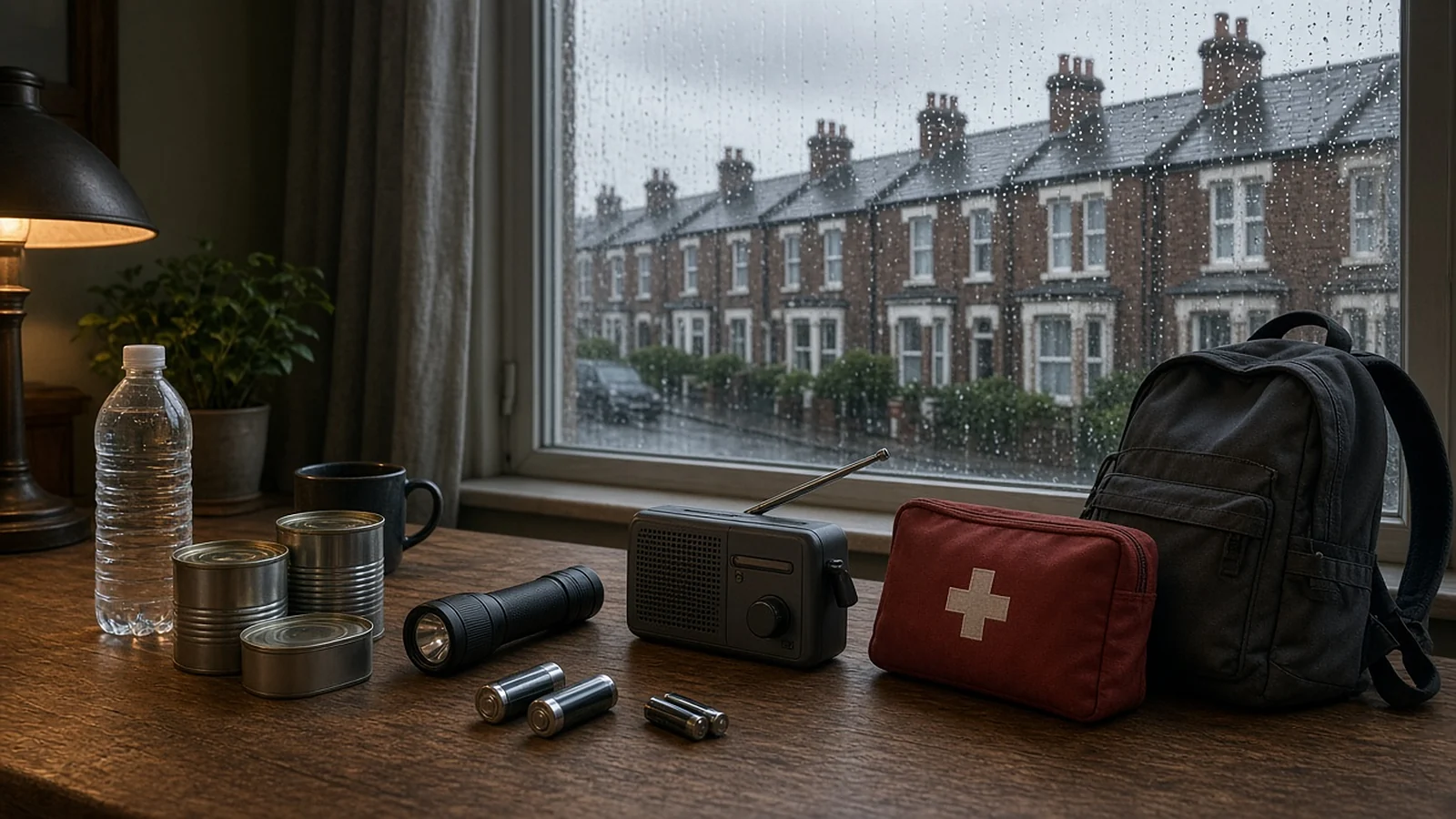
- Light and warmth: a torch (flashlight) with spare batteries, because torches are safer than candles, plus blankets, sleeping bags and warm clothing.
- Communication: a battery or wind-up FM radio, with the frequencies of local stations written down, and a charged power bank.
- Money and documents: cash in a mix of coins and notes, in case electronic payments or ATMs are disrupted, plus printed copies of IDs, insurance details and instructions for any medical equipment.
- Important numbers: emergency contacts and a written list of regular medications and doses.
- Medical: a first aid kit and essential medication, with repeat prescriptions requested in good time.
- Babies and pets: ready-to-feed formula (because you may not be able to boil water), nappies and wipes, and pet food and water.
The campaign’s tone is just as useful as its list. It says you don’t need to do it all at once. Check what you already have, buy an extra item or two on regular shopping trips, and set a reminder every six months to check expiry dates.
What this means for your household
The UK’s advice was written for British families, but none of it is foreign to an American home. Our own Ready.gov guidance asks families to have enough food, water and supplies to last several days, and to store at least one gallon of water per person per day. For drinking alone, the UK’s 3 litres is a little less than a gallon. Ready.gov’s gallon also covers sanitation, so use the American figure for your planning.
Here is a calm, one-weekend way to put this into practice.
1. Count your three days of water
Multiply the people in your home by one gallon by three days. A family of four needs at least 12 gallons. Our guide, How Much Water to Store for an Emergency, walks through storage and how to make water safe.
2. Build three days of food you already eat
Take the UK’s advice to heart: store what your family normally eats. Canned meats and fish, beans, peanut butter, crackers, dried fruit and nuts all work. Include a manual can opener. See our Emergency Food Supply List for a fuller plan.
3. Put light, warmth and a radio in one place
Flashlights for every person, spare batteries, blankets and a battery or hand-crank radio. Our Power Outage Checklist covers what to do before, during and after the lights go out.
4. Keep a little cash at home
The UK checklist recommends cash in case electronic payments or ATMs are disrupted, and Ready.gov notes that an extended power outage can close ATMs and banks. Keep small bills you can actually spend. Our guide How Much Should Your Emergency Fund Be? helps you think it through.
5. Write the important things on paper
Phone numbers, medications and doses, insurance policy numbers. A phone with a dead battery can’t tell you anything. Store the paper copy with your kit.
6. Check on the vulnerable
The UK’s Priority Services Register exists so utilities know who needs extra help. In the U.S., the closest step is to contact your own electric and water utility and ask whether they keep a medical or special-needs list, especially if someone in your home relies on powered medical equipment. Then do what the UK campaign asks of every neighbor: agree who will check on an older person or someone living alone if the power goes out.
7. Assemble your kit
Our Emergency Kit Checklist and First Aid Kit Checklist bring it all together in one place.
Preparing as an act of love
Notice the reason the British government gave for asking: if the households who are able to prepare do so, emergency services can reach those most in need first. Preparation, in other words, is not selfish. A family with three days of water in the closet is a family that doesn’t need rescuing, and that may have a little to share.
That is a deeply Christian idea. We prepare not to hide from our neighbors but to be ready to serve them.
“Bear ye one another’s burdens, and so fulfil the law of Christ.”
Galatians 6:2 (KJV)
Your one faithful step this week
Before Sunday, open your pantry and your closet. Count how many days of water and food your household already has, write the number on a sticky note, and put it on the refrigerator. If it’s fewer than three, add one case of water or a few cans to this week’s shopping list. Then call or text one neighbor and swap phone numbers.
Calm, steady and faithful. That is how a household gets ready.
Sources
- GOV.UK (Cabinet Office): Households encouraged to take small, simple steps to stay prepared in an emergency, Oct. 22, 2026
- UK Government Be Ready campaign: Be ready for emergencies (checklist)
- The Guardian: Every Briton should stockpile water and food supplies, government advises, Oct. 22, 2026
- BBC News: Why should I stockpile and what will I need?
- Ready.gov: Build a Kit
- Ready.gov: Power Outages
Related reading
- Emergency Kit Checklist for Families
- How Much Water to Store for an Emergency
- Power Outage Checklist
General educational content, not individualized medical, safety, engineering, or financial advice. Follow your local officials and qualified professionals. In an emergency, call 911 (U.S.). See our Disclaimer.
Get one faithful step every week
The Shepherd’s Letter: Scripture, a short teaching, and one practical step for your household. Free.
Leave a Reply