
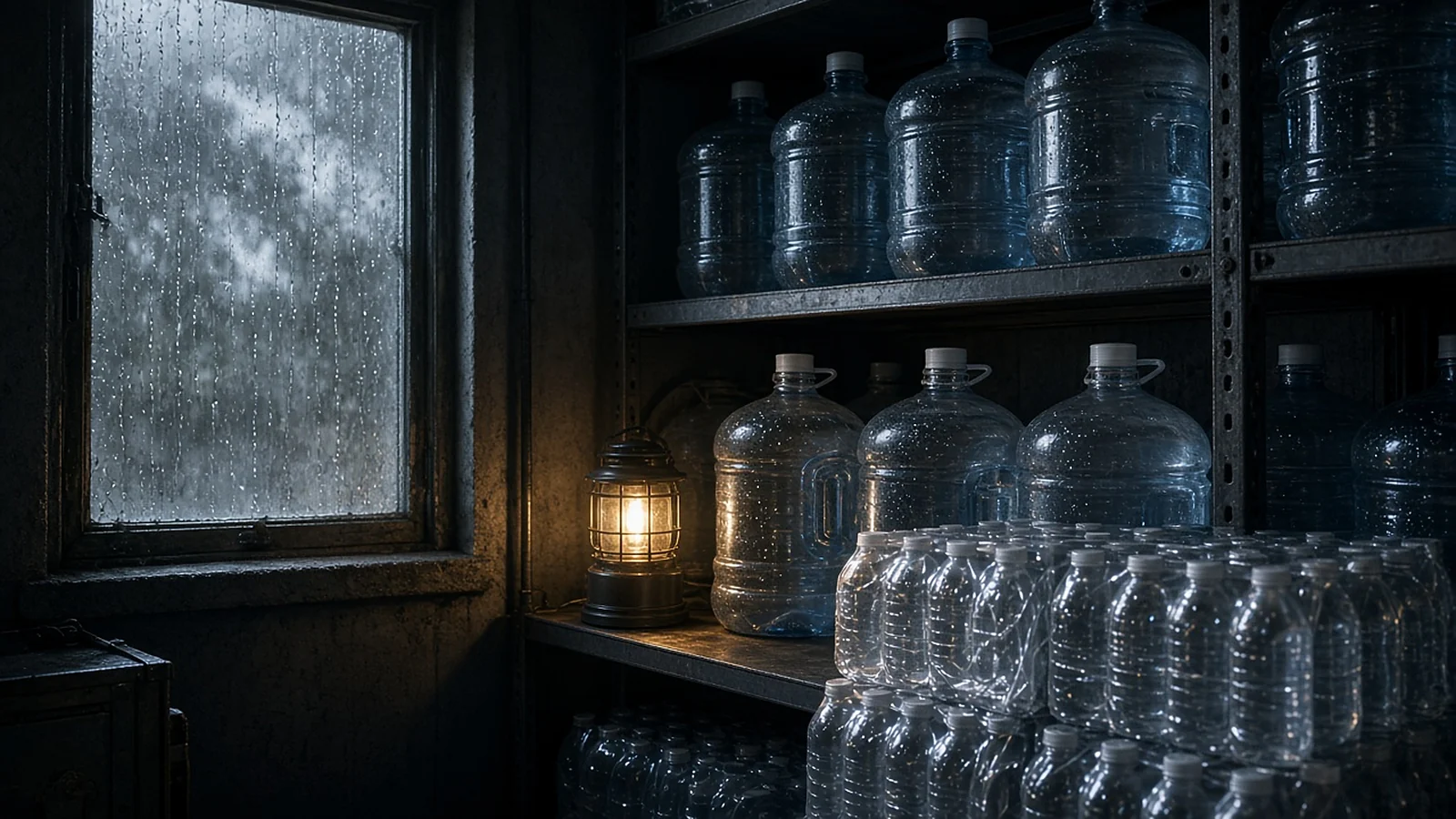
Of everything a household can store for an emergency, water matters most. Food can stretch. Water cannot. After a storm, a water main break, or a flood, your tap may be turned off, or the water coming out of it may not be safe. A little planning now means your family does not have to scramble later.
This guide covers three things: how much water to store, how to store it so it stays safe, and what to do if you run out and need to make water safe to drink. Everything here comes from Ready.gov, the Centers for Disease Control and Prevention (CDC), and the American Red Cross, and we link each source so you can read the guidance yourself.
How much water should you store?
Ready.gov’s guidance is to store at least one gallon of water per person per day for several days, for drinking and sanitation. The American Red Cross gives a helpful time frame for that same gallon-per-person-per-day rule: a 3-day supply for evacuation and a 2-week supply for home.
To put that into practice, multiply:
People in your home × 1 gallon × number of days = gallons to store
A household of four planning for three days would store at least 12 gallons. The same household planning for two weeks at home would store at least 56 gallons. Write your own number down. Seeing it on paper turns a vague worry into a plan you can work toward.
When you need more than a gallon
Ready.gov notes that a normally active person needs about three quarters of a gallon of fluid daily, from water and other beverages, but that individual needs vary with age, health, physical condition, activity, diet, and climate. Plan for more water if:
- You have children, nursing mothers, or anyone who is sick in the home. They may need more.
- Someone has a medical need that could require additional water.
- You live in a warm climate. Ready.gov notes that in very hot temperatures, water needs can double.
- You have pets. Ready.gov lists extra water for your pet, and the Red Cross lists pet supplies such as food and a bowl.
How to store water safely
The simplest option: commercially bottled water
Ready.gov recommends buying commercially bottled water and storing it in the sealed original container in a cool, dark place. It is the easiest choice to keep track of: check the date on the package and rotate it into everyday use before it expires.
Filling your own containers
If you prepare your own containers of water, Ready.gov recommends:
1. Use food-grade water storage containers.
2. Clean them thoroughly with dishwashing soap.
3. Sanitize them with a solution of one teaspoon of non-scented liquid household chlorine bleach to a quart of water before filling with chlorinated water.
4. Replace water that has not been commercially bottled every six months.
A dated label on each container makes the six-month rotation easy. Put a reminder on the family calendar for the swap.
Where to keep it
Choose a cool, dark spot away from direct sunlight. Spread your supply across more than one location if you can, so a single leak or problem does not take all of it. And remember the kit: a few gallons in your go-bag or car means water travels with you if you have to leave.
Water tips during an emergency
Ready.gov offers practical guidance for when you are actually using your stored supply:
- Never ration drinking water unless authorities tell you to. Drink the amount you need today and try to find more for tomorrow. You can reduce how much water your body needs by reducing activity and staying cool.
- Drink water you know is not contaminated first.
- Do not drink carbonated or caffeinated beverages instead of water. Caffeinated drinks and alcohol dehydrate the body, which increases the need for drinking water.
What not to use
According to the CDC, if you know or suspect your water is unsafe, do not use it to drink, wash dishes, brush your teeth, wash or prepare food, wash your hands, make ice, or make baby formula. Use bottled, boiled, or treated water instead.
The CDC also warns: never use water from radiators or boilers that are part of your home heating system for drinking, cooking, or hygiene. And you cannot make water containing fuel, toxic chemicals, or radioactive materials safe by boiling or disinfecting it. If you suspect that kind of contamination, use bottled water or another source, and contact your health department.
How to make water safe if you run out
Always follow instructions from your local health department first. When they are not available, the CDC describes several methods.
Boiling: the best way to kill germs
The CDC says boiling is the best way to kill germs in water. Its steps:
1. If the water is cloudy, filter it through a clean cloth, paper towel, or coffee filter, or let it settle and draw off the clear water.
2. Bring clear water to a rolling boil for 1 minute. At elevations above 6,500 feet, boil for 3 minutes.
3. Let the boiled water cool.
4. Store it in clean, sanitized containers with tight covers.
Boiled water can taste flat. The CDC suggests pouring it from one container to another and letting it stand for a few hours, or adding a pinch of salt for each quart or liter.
Disinfecting with household bleach
If you cannot boil water, the CDC explains how to disinfect it with unscented household chlorine bleach. First, follow the instructions on the bleach label for disinfecting drinking water. If the label has none, check the concentration of sodium hypochlorite. For typical U.S. bleach at 5% to 9%, the CDC’s table says:
- 1 gallon of water: 8 drops of bleach (or ½ mL, or a little less than ⅛ teaspoon)
- 5 gallons of water: 40 drops of bleach (or 2½ mL, or ½ teaspoon)
If the water is cloudy, murky, colored, or very cold, the CDC says to double the amount. Stir well and let the water stand for at least 30 minutes before drinking. Bleach with a different concentration needs a different amount, so read the CDC’s full table for 1% bleach and other volumes.
One caution from the CDC: chemical disinfectants do not work as well as boiling against some parasites, including Cryptosporidium and Giardia.
Filters, tablets, and UV
The CDC also covers portable filters, tablets, UV light, and solar disinfection. Key points:
- Portable filters do not remove viruses. After filtering, add a chemical disinfectant to kill viruses and bacteria.
- Tablets or drops (chlorine dioxide, chlorine, or iodine) should be used exactly as the label says. People who are pregnant, have thyroid problems, or are sensitive to iodine should avoid iodine-treated water, and no one should drink it for more than a few weeks at a time.
- UV and solar methods do not work well in cloudy water, so filter or settle the water first.
A simple water plan for your household
1. Calculate your number. People × 1 gallon × days. Start with three days, then work toward two weeks.
2. Buy or fill a little at a time. A few gallons per shopping trip is enough to build momentum.
3. Label and date anything you fill yourself, and set a six-month reminder.
4. Keep supplies for treatment on hand: unscented bleach (check the date, since bleach weakens over time), a dropper, coffee filters, and a pot for boiling.
5. Talk about it as a family. Make sure everyone knows where the water is and why it matters.
Water is one of the clearest ways to love the people under your roof. It is quiet, unglamorous preparation, and it is exactly the kind of faithfulness that pays off when the day comes.
Frequently asked questions
How long does stored water last?
Ready.gov recommends keeping commercially bottled water sealed in its original container in a cool, dark place, and replacing water that has not been commercially bottled every six months. Check the date on store-bought water and rotate it into daily use.
Can I use water from my water heater or home pipes?
Our sources do not cover water heaters, so check with your local health department or water utility before relying on them. The CDC does warn never to use water from radiators or boilers that are part of your home heating system.
Is it okay to ration water to make it last?
Ready.gov says never to ration drinking water unless authorities order you to. Drink what you need today and look for more for tomorrow.
Your one faithful step this week
Do the math for your household and write the number on your refrigerator. Then add your first few gallons of water to the place where you keep your emergency supplies.
Sources
- Ready.gov: Water
- Ready.gov: Build a Kit
- CDC: How to Make Water Safe in an Emergency
- American Red Cross: Survival Kit Supplies
Related reading
General educational content, not individualized medical, safety, engineering, or financial advice. Follow your local officials and qualified professionals. In an emergency, call 911 (U.S.). See our Disclaimer.
Get one faithful step every week
The Shepherd’s Letter: Scripture, a short teaching, and one practical step for your household. Free.
Leave a Reply