
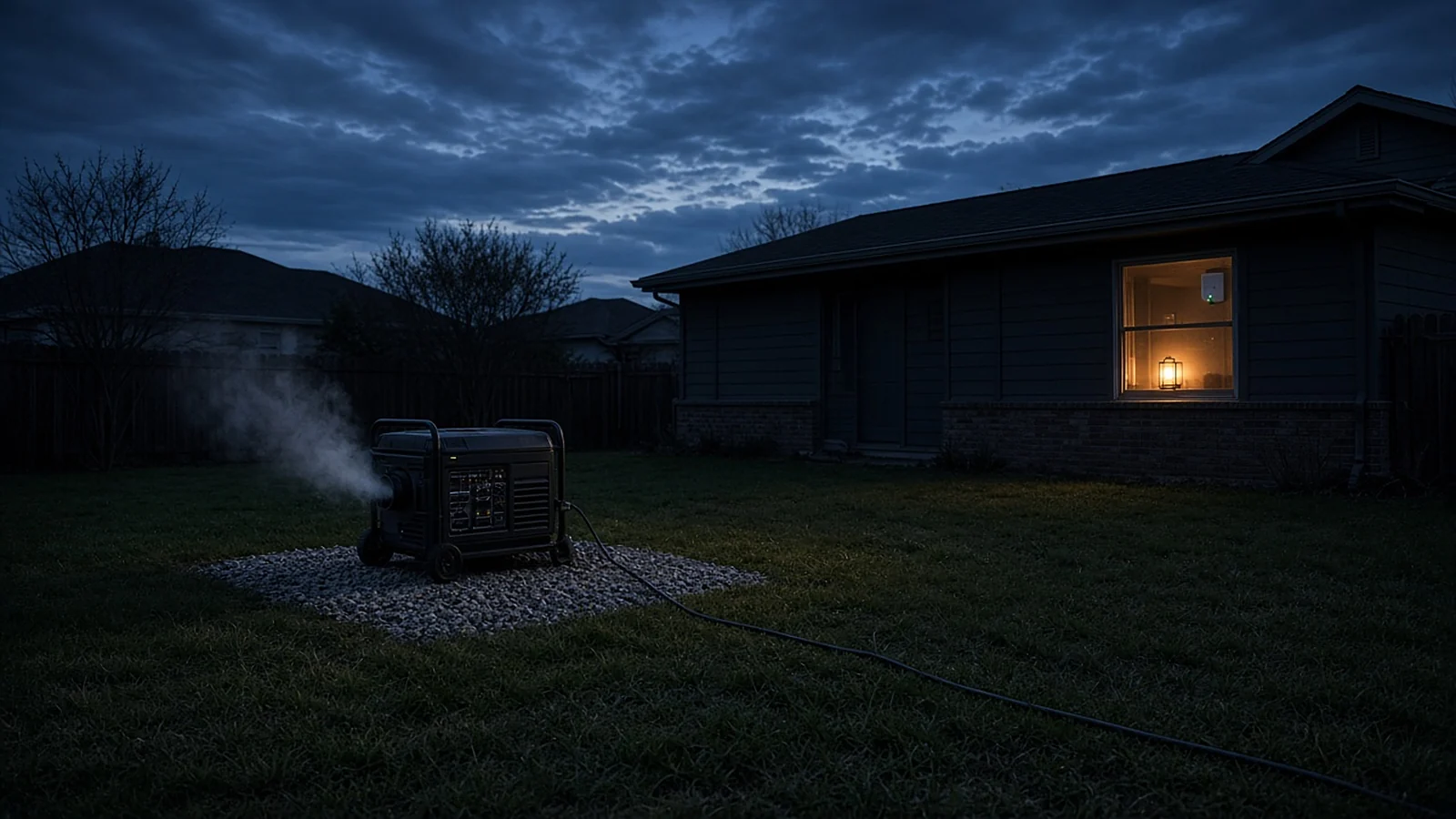
When the power has been out for a day and the house is growing cold or hot, a portable generator can feel like a gift. It runs the refrigerator, charges phones, and keeps a fan or a lamp going. Used carelessly, though, it can also fill a home with a poison no one can see or smell.
Carbon monoxide (CO) is the reason. The Centers for Disease Control and Prevention (CDC) calls it an odorless, colorless gas that kills without warning, and lists portable generators among the household items that produce it. The good news is that the safety rules are clear, simple, and the same across every agency. This guide gathers them from the CDC, the U.S. Consumer Product Safety Commission (CPSC), and Ready.gov, so your family can use backup power without that risk.
Keeping watch over a household includes the things we cannot see. This is one of them.
Why generators are so dangerous indoors
Generator exhaust contains carbon monoxide. The CPSC puts it bluntly: CO from a generator is deadly and can kill you in minutes. One generator produces as much CO as hundreds of cars.
The numbers from federal agencies show why this matters:
- The CDC says that each year, more than 400 Americans die from unintentional CO poisoning not linked to fires, more than 100,000 visit an emergency department, and more than 14,000 are hospitalized.
- The CPSC reports that an average of nearly 100 people die in the U.S. each year from CO poisoning caused by portable generators, according to its latest report on non-fire carbon monoxide deaths associated with consumer products.
The CPSC also warns that generator CO poisoning can happen so quickly that people may become unconscious before they recognize the symptoms of nausea, dizziness, or weakness. That is why you cannot rely on “feeling fine.” The rules below have to be followed every time.
The rule that saves lives: outside and at least 20 feet away
Every agency gives the same core instruction, with slightly different wording:
- Ready.gov: Generators and fuel should always be used outdoors and at least 20 feet away from windows, doors, and attached garages.
- CDC: Only use generators outside, more than 20 feet away from any windows, doors, and vents. Never use a generator inside your home or garage, even if doors and windows are open.
- CPSC: Never operate a portable generator inside a home, garage, basement, crawlspace, shed, or other enclosed space. Opening doors or windows will not provide enough ventilation to prevent lethal levels of CO.
The CPSC adds several details families often miss:
- Don’t operate a generator on a porch or in a carport. It is too close to the home.
- Direct the exhaust away from your home and away from the entrances of other buildings, including a neighbor’s.
- Close windows and seal off vent openings that are near the generator or in the path of its exhaust.
A simple way to remember it: if the generator is under a roof, attached to the house, or close enough to breathe on a window, it is in the wrong place.
Carbon monoxide alarms: your second line of defense
Placement is the first defense. A working CO alarm is the second, and it is just as important.
- Ready.gov says to install working carbon monoxide detectors with battery backup on every level of your home.
- The CDC says to install battery-operated or battery-backup CO detectors near every sleeping area, and when using a generator, to use a battery-powered or battery-backup CO detector in your home.
- The CPSC recommends alarms on each level of the home and outside separate sleeping areas, and says interconnected alarms are best, because when one sounds, they all sound.
Battery backup matters because the reason you are running a generator is that the power is out. A plug-in alarm with no battery will be silent exactly when you need it.
Keep your alarms working
- Test monthly. The CPSC recommends testing CO and smoke alarms monthly and replacing batteries as needed.
- Check batteries at the clock change. The CDC suggests checking CO detector batteries when you change your clocks each spring and fall.
- Replace on schedule. The CDC says to replace your CO detector following the manufacturer’s instructions or every 5 years.
If the alarm sounds
The CPSC is clear: never ignore an alarm when it sounds. Get outside immediately, then call 911. Do not stop to search for the source. Get everyone, including pets, into fresh air first.
Know the symptoms of CO poisoning
The CDC lists the most common symptoms of carbon monoxide poisoning as:
- Headache
- Dizziness
- Weakness
- Upset stomach
- Vomiting
- Chest pain
- Confusion
The CDC notes these symptoms are often described as “flu-like.” If several people in the home, or pets, feel sick at the same time while a generator or other fuel-burning device is running, treat it as possible CO poisoning.
The CDC also warns that people who are sleeping, drunk, or under the influence of other substances can die from CO poisoning before they have symptoms, and that infants, the elderly, and people with chronic heart disease, anemia, or breathing problems are more likely to get sick from CO.
If you suspect CO poisoning, get everyone outside to fresh air right away and call 911. Do not go back in until emergency responders say it is safe.
Refueling safely
Fuel is the other hazard. Ready.gov says: let the generator cool before refueling. Fuel spilled on hot engine parts can ignite.
Practical habits that follow from that guidance:
- Turn the generator off and give it time to cool before adding fuel.
- Refuel outdoors, never in a garage or shed.
- Follow the manufacturer’s instructions carefully, as both Ready.gov and the CPSC advise, including any guidance on fuel type and storage.
Cords, water, and shock hazards
Carbon monoxide is not the only risk. Ready.gov also warns about electrical shock:
- Keep the generator dry and protected from rain or flooding. Touching a wet generator, or devices connected to one, can cause electrical shock.
- Always connect the generator to appliances with heavy-duty extension cords.
- Follow the manufacturer’s instructions carefully.
The CPSC adds that you should follow the manufacturer’s instructions about shock hazards in bad weather, which may include using an NFPA-rated noncombustible generator tent or may advise you to wait until rain or snow passes.
If you are thinking about connecting a generator directly to your home’s wiring, do not improvise. Talk with your electric utility and a licensed electrician first.
Choosing and maintaining a generator
If you are shopping for a portable generator, the CPSC suggests looking for models with a CO shut-off safety feature, which automatically shuts the generator off when dangerous CO levels build up nearby. In its May 2026 hurricane-season release, the CPSC noted that models certified to the PGMA G300-2023 and UL 2201-2023 standards include carbon monoxide safety technologies, and that UL 2201-certified models also have reduced CO emissions. See the CPSC hurricane season release for details.
Whatever model you own, the CPSC recommends that you regularly check and maintain your portable generator so it works when needed, and that you read and follow all labels, instructions, and warnings on the generator and in the owner’s manual. A test run in good weather, outdoors and at a safe distance, is far better than learning how it works during a storm.
Other CO sources during an outage
Generators are not the only danger when the power goes out. The same agencies warn about:
- Gas stoves and ovens: Ready.gov says do not use a gas stove or oven to heat your home. It increases the risk of carbon monoxide poisoning, fires, and burns.
- Charcoal and camp stoves: The CDC says never burn charcoal indoors and never use a portable gas camp stove indoors. The CPSC adds: do not cook on a charcoal grill in a garage, even with the door open.
- Cars: The CDC says never run your car or truck inside a garage attached to a house, even with the garage door open. If you charge a phone in the car, the Department of Energy advises making sure the car is in a well-ventilated place.
If heat or cold becomes dangerous, Ready.gov recommends going to a community location with power. Check with local officials about heating and cooling centers near you. Our power outage food safety guide covers what to do with the refrigerator and freezer while you wait.
A short generator safety checklist
Print this and tape it near the generator:
- Generator outdoors only, at least 20 feet from windows, doors, vents, and attached garages
- Never in a garage, basement, shed, porch, or carport
- Exhaust pointed away from the house and neighbors
- Battery-backup CO alarms on every level and near sleeping areas, tested monthly
- Generator dry; heavy-duty extension cords only
- Cool down before refueling
- Alarm sounds or anyone feels sick: everyone outside, then call 911
Frequently asked questions
How far from the house should a generator be?
Ready.gov and the CPSC say at least 20 feet. The CDC says more than 20 feet from any windows, doors, and vents. Point the exhaust away from the home.
Is it safe to run a generator in the garage with the door open?
No. The CDC and CPSC both say never run a generator in a garage, even with doors or windows open. Open doors do not provide enough ventilation to prevent deadly CO levels.
What are the first signs of carbon monoxide poisoning?
The CDC lists headache, dizziness, weakness, upset stomach, vomiting, chest pain, and confusion. People who are asleep may have no warning. Get to fresh air and call 911.
Do I need a CO alarm if I don’t own a generator?
Yes. The CDC notes that CO is produced any time fuel is burned in cars, small engines, stoves, lanterns, grills, fireplaces, gas ranges, or furnaces. Battery-backup alarms on every level are a good idea in any home with fuel-burning appliances.
Your one faithful step this week
Walk through your home and find your carbon monoxide alarms. If you have none, or none with battery backup, put one on your list for every level of the house. If you have them, press the test button on each one tonight. Then pace out 20 feet from your nearest window so the whole family knows where a generator would have to sit.
“A prudent man foreseeth the evil, and hideth himself: but the simple pass on, and are punished.”
Proverbs 22:3 (KJV)
Sources
- CDC: Carbon Monoxide (CO) Poisoning Basics
- CPSC: Generators and Engine-Driven Tools
- CPSC: Winter Weather Safety Tips to Prevent Fires and Carbon Monoxide Poisoning (March 16, 2026)
- CPSC: Generator, Carbon Monoxide and Fire Hazards Ahead of Hurricane Season (May 27, 2026)
- Ready.gov: Power Outages
- U.S. Department of Energy: Keeping Mobile Devices Charged
Related reading
General educational content, not individualized medical, safety, engineering, or financial advice. Follow your local officials and qualified professionals. In an emergency, call 911 (U.S.). See our Disclaimer.
Get one faithful step every week
The Shepherd’s Letter: Scripture, a short teaching, and one practical step for your household. Free.
Leave a Reply